Now Get Relief from Train Delays: In a game-changing move, Railways is linking its trains to a satellite network of ISRO to collect real-time updates on the train, making sure the train is on time through an accurate and efficient system.

Indian Railways is linking its trains to an ISRO satellite. How will it use 1.4 crore daily updates?

It is 2.58 pm on Monday. An Indian Railways (IR) controller, Kapil Dev, is focusing on one train — No. 22430, Pathankot-Delhi Superfast Express, which has just departed from Karnal station in Haryana.

The next half hour will be critical for Dev, located in New Delhi’s control room, as well as a group of track maintainers waiting on the outskirts of Panipat Junction. By the time the train reaches Panipat, it will have run past four lesser known stations — Bazida Jatan, Gharaunda, Kohand and Babarpur. The track maintainers have asked for what’s called a block in railways jargon, which means no other train will run on that stretch while the block is enforced for repair.

At the control room, Dev has a quick telephonic conversation with the Panipat station master even as he takes a close look at his colour-coded dashboard showing movement of trains — freight, passenger, express — before granting a 15-minute block near Panipat.

For Dev & his fellow controllers taking impromptu and sensitive decisions on train movements in 305 section controls spread across India, what has emerged as a gamechanger is the Indian Space Research Organisation’s GAGAN (GPS Aided GEO Augmented Navigation), a satellite-based augmentation system (SBAS) that was initially developed for the Indian airspace. It now relays train-running data — both location and speed — every 30 seconds, making the system far more accurate and efficient.

Dev, who was a railway guard in Jind till he cleared a departmental examination and got promoted, is one of 38 section controllers stationed in Delhi. In his own section, between Delhi and Ambala, he is fully empowered during his six-hour shift to halt a train or allow it to move forward on a priority basis, and even to grant a block for repair.

The key difference is that now a controller does not need to manually feed data, which means he has more time to plan more effectively train movements, including halts. This has the potential to improve punctuality in IR. A controller, for example, can intervene if a train runs at 60 or 70 kmph when the maximum permissible limit in that section is 100 kmph. Earlier, only details of arrival, departure and running through stations were recorded. Half of IR’s 12,000-odd locomotives are now enabled with Real-time Train Information System (RTIS) that relays signal via GSAT satellites that have GAGAN payloads. The project has cost the IR Rs 120 crore since January.

The entire network is expected to be covered in a year’s time, say railway officials. ET Magazine has withheld the name of the specific satellite that is being used by the IR as it is considered strategic, demanding confidentiality. This radical change of track, embracing satellite technology, was first seen on the ground on January 8 when the IR rolled out RTIS in a few routes such as Mumbai-Katra, New Delhi-Patna, New Delhi-Amritsar and Delhi-Jammu. Earlier, the ISRO had conducted a pilot project in July-September 2017.

The system being adopted works as follows: A locomotive is fitted with an RTIS device, which has two units — one is kept in the engine and the other placed on top. SIMs (subscriber identification modules) of two mobile operators — Airtel and Vodafone — are placed in it. However, thanks to the use of a dedicated satellite, tracking train movements is possible even in areas where there is poor or no mobile connectivity. The RTIS device uses GAGAN to transmit signal.The satellite then relays data first to the control hubs, which finally reaches the railway enquiry system. Both passengers and freight customers receive a more accurate information on train status when the train concerned is connected to a locomotive equipped with RTIS.

“Apart from knowing the exact location and speed of a train, this ISRO-aided system will help us in future planning. In case of a disaster, the driver can directly communicate with the control room by just pressing a button,” says Railway Board chairman Vinod Kumar Yadav. ET Magazine boarded a locomotive fitted with the new system and also spent 15 minutes in Delhi’s control room to piece together this story on how this system is being put to practice.

Loco pilot Surendra Kumar, who was introduced to the new system only a couple of months ago, explains how it functions. “Before the journey begins, I need to key in my user name, password, train number and date. The system gets activated and keeps relaying information to the section control. Multiple emergency messages, for example, running over cattle, can be relayed to the control room,” he says. Kumar and assistant loco pilot Navdeep Kumar were on duty at the New Delhi railway station early this week when this writer met them. Significantly, as the location and speed are relayed every 30 seconds, the IR can easily locate its trains between stations as well.

Further, unscheduled stoppages can be detected and interventions made. It also allows loco pilots to send emergency messages to the control room. This is significant as drivers are strictly not allowed to use their mobile phones for reasons of safety. Now, the driver simply needs to push one of the six buttons on the new device to alert the control room and apprise it of the nature of the fault — coach-, track- or engine-related, or running over an animal.

While the immediate gains of the satellite-enabled relaying of data are visible, the system will turn out to be far more productive if the IR finds multiple ways to analyse and use the humongous volume of data that it receives daily, for its future planning. The correlating of this new data with the information on tracks and topography that the IR already has may open new windows on research and development.

According to Mukesh Nigam, managing director of CRIS (Centre for Railway Information System), an IR arm that is the custodian of such data, there are 14 million daily updates at present, up from a mere half a million before January 8. Once all 12,000 locomotives are equipped with the system in a year, the volume of data is expected to rise to 30 million daily updates, he adds.

Can the system in its final avatar forecast for the driver the scenarios that could happen on the track? “Yes, there is potential to give forecasts to drivers when trains approach a neutral section (no-electricity zone) so that drivers can lower the pantograph (an apparatus mounted on the roof of an electric train). We are still working on this,” says Nigam. The only concern is, what if the 30 million daily updates become too voluminous to handle and remain mere statistics?

Controllers can now plan train movements better: Mukesh Nigam, MD, Centre for Railway Information Systems

Mukesh Nigam, managing director of the Centre for Railway Information Systems, the IR arm that is anchoring the project linking locomotives to a GSAT satellite, tells ET how this makes manual plotting of train movements redundant and improves punctuality. Edited excerpts:

How is the satellite-enabled real time train information system different from the one used in the past?
We are now making use of an ISRO satellite. The ISRO has given us a bandwidth for our locomotives to transmit data every 30 seconds. Our data centre receives the GPS/GAGAN updates from the devices placed on locomotives, and control rooms across the Indian Railways network receive the updates. The system works even in remote areas where mobile connectivity is very poor or nil

How has its progress been after the system was first rolled out in January?
We have so far put the system on 6,000 locomotives. By the end of this month, it will be installed on another 300-400 locomotives. We expect all locomotives (about 12,000) to be covered by the scheme in a year.

How will the railways benefit from this system?
First of all, we are now getting more accurate information on the location of trains, as updates come every 30 seconds. Both our passengers and freight customers are benefitting from it. Second, it is very helpful for section controllers (those controlling the movement of trains real-time over the phone with station masters). Let us not forget that the volume of railway traffic in several sections has substantially gone up. So, plotting of trains manually has become very difficult. Here, charting takes place automatically, which means, the controller does not need to use her hand to plot the movement of a train on the chart. So, the controller can now concentrate more on her real task, which is planning the movement of a train.

Can this system help the railways in long-term strategic planning?
The volume of data that has started coming in is enormous. Earlier, we used to receive 500,000 updates daily — on arrivals, departures and running through stations. Now we receive mid-section updates every 30 seconds. That is why the daily updates are now about 1.4 crore. When we cover the entire fleet, the data on train running will shoot up to about 3 crore every day.

Such enormous real-time data will help us develop better modules on train running. We will correlate this data with the ones on tracks and other operation-related data that we already have. We have done the GIS (geographic information system) mapping of the entire railway network. The correlation of data will give us better insights into train running, which will help the Indian Railways improve operations. There is also potential to give forecasts to drivers when trains approach a neutral section (no-electricity zone) so that drivers can lower the pantograph (an apparatus mounted on the roof of an electric train). This is only a potential. We are still working on it.

Source:
https://economictimes.indiatimes.com/industry/transportation/railways/indian-railways-is-linking-its-trains-to-isros-satellite-network-how-will-it-improve-its-punctuality/articleshow/71557415.cms


We are working on enhancing the affordability and accessibility of credit flow to exporters. Read my full interview where I talk about increasing India’s trade and leveraging the huge opportunities available internationally

Source : https://timesofindia.indiatimes.com/business/india-business/national-interest-priority-cant-stay-isolated-in-world-trade-says-piyush-goyal/articleshow/71193297.cms

Railways announces several freight incentive measures relating to rate exemptions, digitisation and ease of doing business, to enhance the price competitiveness & efficiency of Railways and give a boost to the economy

Government will soon announce a scheme for Export Credit and is also working on making ECGC procedures exporter friendly, in an effort to enhance accessibility and affordability of credit for exporters.

Indian Railways to enforce ban on single use plastic material

Taking a cue from the Prime Minister, Shri Narendra Modi’s clarion call in his Independence Day speech to eliminate single use plastic in the country from 2nd October, 2019, Indian Railways has once again risen to the occasion to shield the environment from the menace of plastic.Ministry of Railways has directed all Railway unitsto enforce ban on single use plastic material, with less than 50 micron thicknessfrom 2nd October, 2019. Emphasis is on making necessary arrangementsto minimize generation of plastic waste and its eco- friendly disposal.

In this regard, Ministry of Railways has issued a circular stating the following instructions areto be enforced: w.e.f. 02.10.2019:

  1. Ban on single use plastic material
  2. All railway vendors to avoid use of plastic carry bags
  3. Staff should reduce, reuse and refuse plastic products and to use inexpensive reusable bags to reduce plastic footprint.
  4. IRCTC to implement return of plastic drinking waterbottles as part of Extended Producer Responsibility.
  5. Plastic Bottle crushing machines to be provided expeditiously.


Strict enforcement of these instructions is to be from 02.10.2019, to give enough time to all concerned to prepare for “Plastic Free Railway”.

Ministry of Railways has also instructed its Railway units that a pledge can be administered on 2nd October, 2019 to cut use of plastics. Also, Information, Education & Communication (IEC) measures are to be adapted to create awareness among railway users.


Source: https://pib.gov.in/PressReleasePage.aspx?PRID=1582494

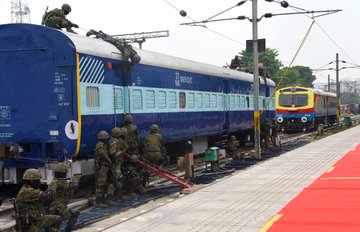
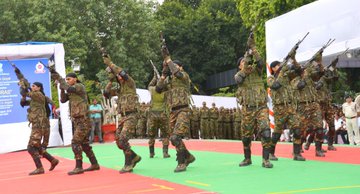
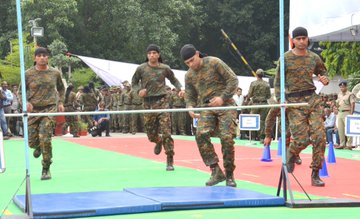
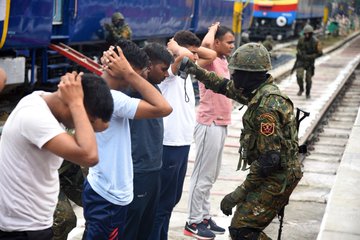
दिल्ली में CORAS (Commandos for Railway Security) के लॉंच कार्यक्रम में भाग लिया। आधुनिक हथियारों और इक्विपमेंट्स से लैस यह कमांडो किसी भी प्रकार की आपात स्थिति में तुरंत रिस्पांस देने में सक्षम है। इससे रेलवे सुरक्षा में कई गुना बढोत्तरी होगी

ImageImageImageImage

Minister of Railways and Commerce &Industry,Shri Piyush Goyal launched CORAS (Commando for Railway Security) of Indian Railways and new establishment manual for Railway Protection Force today. Chairman, Railway Board, Shri Vinod Kumar Yadav, other Railway Board Members,DG, RPF, Shri Arun Kumar, General Manager, Northern Railway, Shri T.P.Singh, along with senior Railway officials were present on the occasion.

Speaking on the occasion, Minister of Railways and Commerce & Industry,Shri Piyush Goyalsaid, “Today we are committed to develop India as a Clean India, Healthy India, Prosperous and Secure India. Keeping in mind the threat from disruptive forces, induction of CORAS was planned in Railway Protection Force. CORAS team will be provided best, most modern equipment and world class training. Lauding the efforts of RPF soldier Shivcharan Gurjar, who rescued eight lives in flood stricken areas of Gujarat, Shri Goyal appreciated the commendable work of RPF soldiers. Shri Goyal urged the people to crack down on touts and immediately inform the authorities so the menace of ticket touting may be eliminated permanently.”

Shri Goyal announced that a new state of the art commando training centre to beestablished in Jagadhri, Haryana. Shri Goyal added that a new network of CCTV cameras at every station will be set up to enhance the security of Railway passengers. The link of these cameras will be given to the local stations, GRP, RPF, Divisional office and to the Minister’s office. Shri Goyal also congratulated RPF officers and each soldier for extending security to passengers and Railway property in far-flung areas round the clock. Shri Goyal thanked Hon’ble Prime Minister, Shri Narendra Modi for taking the concern about the safety of train passengers. Launch of CORAS is an important step in this direction. Shri Goyalalso conveyed his greetings to the Nation on Independence Day and Rakshabandhan.

Speaking on the occasion, Chairman, Railway Board,Shri Vinod Kumar Yadav said, “CORAS, a special Railway Unit is a result of detailed policy formulation. Railway Protection Force is always involved in protecting Railway passengers and Railway property in far and inaccessible threat prone areas. To meet the challenges to Railway security, CORAS, a separate Commando Unit of RPF hasbeen established. This special unit is given world class training and best facilities. This special unit will be able to meet any challenging situation.”

Speaking on the occasion, Director General, Railway Protection Force, Shri Arun Kumar said, “Railway plays an important role in connecting nook and corner of the country. To tackle the threats to Railway passengers or establishments, a special task force having trained manpower was required. Railway is currently carrying out projects, which are strategically and economically important. Commissioning of CORAS will address challenges to these ongoing projects as well as any challenging situation for Railway travellers. The commandos in CORAS are well trained in reputed institutions and are capable of meeting any precarious situation. This new unit will strengthen the Railway security.”

BACKGROUND OF CORAS (Commandos for Railway Security)

VISION STATEMENT

· To develop world level capabilities of specialized responder for any situation pertaining to damage, disturbance, disruption of train operations, attack/hostage/hijack, disaster situations in railway areas.

· Following the doctrine of graded response, minimum effective force shall be used for providing fool proof security to Indian Railways and its users.

SALIENT FEATURES

· Carved out from motivated and willing young staff of RPF/RPSF.

· With an average age between 30-35 years, CORAS will always be young and motivated staff.

· Very high physical standards to join CORAS.

· Commando Coys shall be deployed in Left Wing Extremism (LWE)/Insurgency/Terrorism affected Railway areas.


Source: https://pib.gov.in/Pressreleaseshare.aspx?PRID=1582001

Mission Raftaar: Soon, Delhi-Mumbai and Delhi-Howrah train journey in 12 hours at 160 kmph! This mega plan of Railways will ensure passengers have best-in-class safety, speed and service.

Delhi-Mumbai, Delhi-Howrah overnight train journeys will no longer be a dream! Prime Minister Narendra Modi-led CCEA has given its nod to Indian Railways ambitious project of 160 kmph train journeys.

Delhi-Mumbai rajdhani, Delhi-Howrah rajdhani

Delhi-Mumbai, Delhi-Howrah overnight train journeys will no longer be a dream! Prime Minister Narendra Modi-led Cabinet Committee on Economic Affairs (CCEA) has given its nod to Indian Railways ambitious project of 160 kmph train journeys on Delhi-Mumbai and Delhi-Howrah routes. The nod comes after the project was accorded priority status in Piyush Goyal-led Indian Railways 100 day roadmap plan. What this effectively means for Indian Railways passengers is that soon the Delhi-Mumbai and Delhi-Howrah Rajdhani Express-style trains will be able to complete a trip in just 12 hours, attaining a maximum speed of 160 kmph!

In the recently held Cabinet meet, it was decided that the speed potential on the Delhi-Mumbai route (including Vadodara-Ahmedabad) and the Delhi-Howrah route (including Kanpur-Lucknow) will be increased to 160 kmph over the next few years. While the Delhi-Mumbai project would require an investment of Rs 6,806 crore, the Delhi-Howrah one will cost Rs 6,685 crore. The ambitious projects are expected to be completed by 2022-2

Delhi-Mumbai in 12 hours: Top facts and benefits

  • Travel time between Delhi and Mumbai to come down by 3.5 hours. Presently the fastest Rajdhani Express takes around 15 hours.
  • Impetus to semi-high speed trains like the Vande Bharat Express. LHB coaches fit for 160 kmph speed too.
  • Delhi-Mumbai route passes through Delhi, Uttar Pradesh, Haryana, Rajasthan, Madhya Pradesh, Gujarat and Maharashtra. All 7 states on 1,483 kilometres long route expected to benefit.
  • 60% increase in average speed of passenger trains and doubling of average speed of freight traffic

Delhi-Howrah in 12 hours: Top facts and benefits

  • Travel time between Delhi and Howrah to come down by 5 hours. Presently the fastest Rajdhani Express takes around 17 hours.
  • Impetus to semi-high speed trains like the Vande Bharat Express. LHB coaches fit for 160 kmph speed too.
  • Delhi-Howrah route passes through Delhi, Uttar Pradesh, Bihar, Jharkhand, and West Bengal. All 5 states on 1,525 kilometres long route expected to benefit.
  • 60% increase in average speed of passenger trains and doubling of average speed of freight traffic

Both the projects would involve track fencing, mobile train radio communication system, automatic train protection system (world-class). Additionally, all level crossings will be eliminated on the two routes to be able to attain speeds of 160 kmph. The projects will be funded through extra budgetary resources. The projects will have a multiplier effect, with several crore mandays of jobs being generated. The Delhi-Howrah and Delhi-Mumbai routes together account for 29% of passenger traffic and 20% of freight traffic, hence forming crucial lengths of the Golden Quadrilateral.


Source: https://www.financialexpress.com/infrastructure/railways/delhi-mumbai-delhi-howrah-rajdhani-express-indian-railways-160-kmph-12-hours-trains/1669200/

Railways starts its largest recruitment drive for para-medical staff for over 1900 posts. With 10% reservation for the Economically Weaker Section, the computer based test will be conducted in 15 languages, at 345 centres across 107 cities & towns

Indian Railways will conduct the largest recruitment drive for the Para-Medical categories. The Computer Based Test (CBT) for recruitment to 1923 posts of Para-Medical categories will commence from 19.07.2019. The test will be conducted over three days from 19.07.2019 to 21.07.2019 and on each day there will be three shifts. In this recruitment drive, more than 4.39 lakh candidates will be taking the test which will be held in 345 test Centres in 107 towns/cities across the country.

This is first recruitment by Indian Railways in which reservation for Economically Weaker Sections (EWS) will be available to eligible candidates. Against 10 per cent of the total vacancies earmarked for EWS candidates, 4654 EWS candidates will be appearing in the Tests.

The Computer Based Test will be of 90 minutes duration with 30 minutes extra for Persons with Benchmark Disabilities (PwBDs). The tests will comprise questions from Professional Stream, General Awareness, General Arithmetic, General Intelligence & Reasoning and General Science. There will be multiple choice objective questions.

The questions of the test will be available in 15 different languages, including English and Hindi. The candidates can view the question in English and the language the candidate has opted as the medium of test.

The largest number of candidates applied for this recruitment is from Uttar Pradesh (64,596) followed by Rajasthan (62,772), Maharashtra (38,097), Kerala (35,496).

The noticeable feature of this recruitment is that female candidates out number male candidates, the female candidates constitute 62 per cent of the total candidates. Besides, there are also 28 number of Transgender (TG) candidates in the fray.

The selected candidates will be appointed, inter alia, to the post of Staff Nurse, Dietician, Health & Malaria Inspector, Pharmacist, Optometrist, and Radiographer. More than 50 % candidates will be appearing for the post of Staff Nurse.


Source: http://pib.nic.in/PressReleaseIframePage.aspx?PRID=1579284

The Government cleared doubling of railway line connecting New Bongaigaon to Agthori in Assam. This will improve connectivity and boost ‘Ease of Living’ for people in the State

The Cabinet Committee on Economic Affairs, chaired by the Prime Minister Shri Narendra Modi, has given its approval to construct the New Bongaigaon and Agthori via Rangiya doubling (142.97 km) of Northeast Frontier Railway in Assam with an estimated cost of Rs. 2042.51 crore. The project will be completed by 2022-23 and will be executed by Construction Organization of Northeast Frontier Railway.

The line capacity utilization of the section between New Bongaigaon and Agthori via Rangiya is more than 100%. Traffic on this section will further increase as Rangiya-Murkongselek Broad Gauge line has already been commissioned in 2015-16 and Bogibeel Bridge new line has been commissioned recently. To remove the existing capacity constraints of existing network and to handle the increasing freight and passenger traffic, doubling of New Bongaigaon – Agthori via Rangiya is required. Overall operative performance of New Bongaigaon – Agthori via Rangiya will improve by the doubling and congestion of section will also reduce to the great extent.

The project will ease the growing through traffic into the North East region and saving due to faster mobility through the proposed double line section. This project will also generate direct employment during construction for about 34.31 lakh mandays.

The alignment for the approved doubling from New Bongaigaon to Agthori via Rangiya (142.97 km) will traverse through Bongaigaon, Baksa, Barpeta, Nalbari and Kamrup districts of Assam.


Source: http://pib.nic.in/PressReleaseIframePage.aspx?PRID=1579127

Delhi

Vanijya Bhawan, 16, Akbar Rd, New Delhi - 110001

Mumbai

Lok Kalyan Karyalay - 56, Balasinor Society, SV Road, Opp Fire Brigade, Kandivali West, Mumbai, Maharashtra, 400067